


The Divine Jade of Pre‑Historic East: The Sun‑God Figurine of Hongshan Culture
Foreword
Long before written records took shape across the Eurasian continent, deep within the rolling mountain ranges and river valleys of ancient Northeast China, a splendid pre‑historic civilization bloomed, leaving behind mysterious jade relics that still shock the modern world. Among countless masterpieces of Hongshan jade art, the Sun‑God figurine stands as the supreme spiritual totem. Carved from nephrite, condensed with thousands of years of ritual faith, this figurine is far more than an ancient jade ornament. It is a tangible carrier of pre‑historic cosmology, a witness to the birth of early Chinese religious thinking, and one of the most coveted high‑ancient jade collectibles on the global antique market.
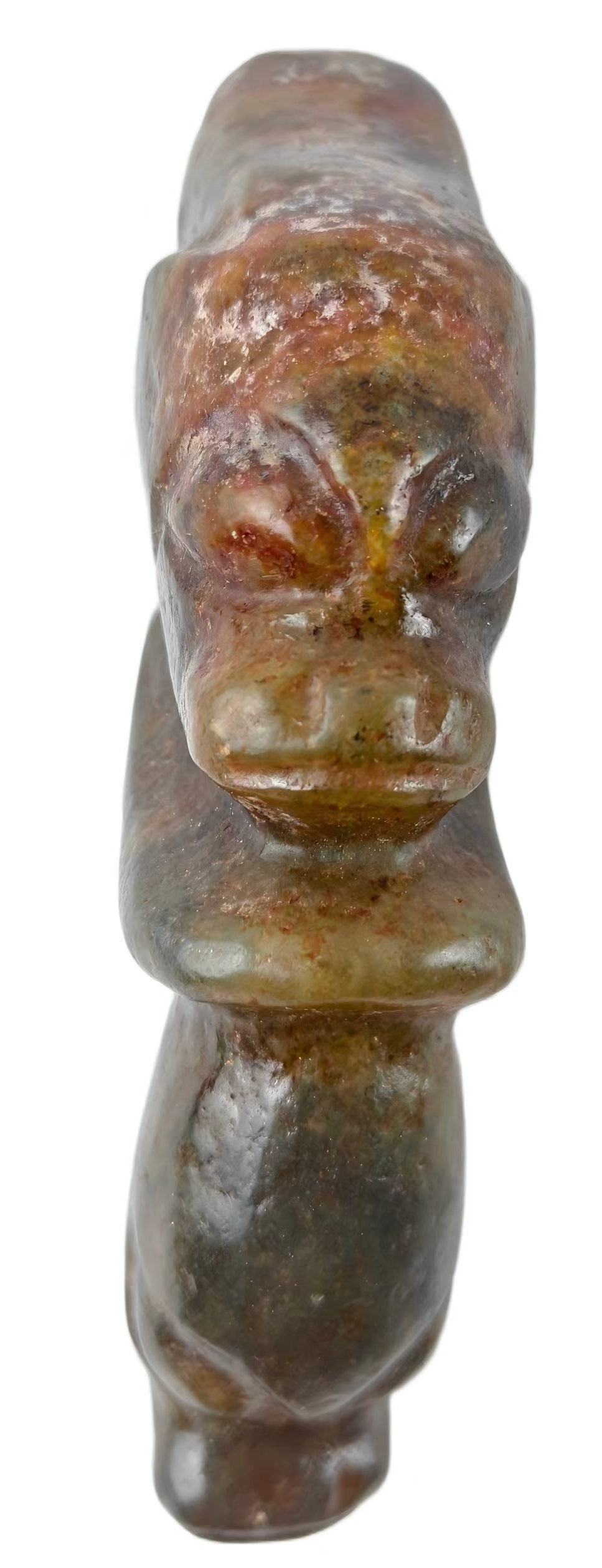
This Hongshan‑style Sun‑God human‑form jade artifact preserves complete modelling features, original carving traces, natural ancient weathering and transitional patina formed by long‑term underground burial. Every curve, every hole, every subtle change of jade skin tells the grand spiritual world of our remote ancestors. When modern eyes gaze upon this small but imposing jade figure, we cross more than five thousand years of time, and touch the original worship of sun, heaven and ancestor from the dawn of Chinese civilization.
Chapter Ⅰ The Historical Background of Hongshan Culture — The Dawn of Chinese Jade Civilization
Hongshan Culture flourished roughly from 4700 BCE to 2900 BCE, distributed mainly in today’s western Liaoning, southern Inner Mongolia and northern Hebei regions. It represents a highly developed agricultural‑pastoral mixed pre‑historic society. Unlike many primitive tribes focused merely on survival production, Hongshan society possessed complex social stratification, large‑scale sacrificial sites, special craft workshops for jade processing, and a complete set of primitive religious systems.
Archaeological excavations have uncovered grand ritual sites: stone altars, goddess temples, large‑scale burial cemeteries for tribal nobles. Jade artifacts were not daily consumer goods for ordinary clansmen. Jade was the medium connecting human world and supernatural heaven. Only tribal chieftains, wizards and high‑rank priests could own and use jade ritual wares. In Hongshan society, jade equals power, divinity and ancestral identity.
The Hongshan jade system includes well‑known classic types: jade dragon, jade pig‑dragon, jade bird, jade cicada, jade hoop, cloud‑shaped jade ornaments, and human‑form jade statues. Among all these categories, human‑shaped jade works are the rarest. Human‑theme jade reflects ancestors’ thinking about self‑existence, soul, ancestor‑god and cosmic divinity. The Sun‑God figurine occupies the apex position of human‑form Hongshan jade.
Most Hongshan jade relics unearthed scientifically are collected in state‑run museums. Complete, well‑preserved Sun‑God jade figurines available for private collection are extremely scarce in the international market. Each surviving private‑held specimen carries huge historical information and irreplaceable collection value.
Hongshan Culture profoundly influenced the origin of later Chinese ritual jade tradition. The core concept of “using jade to communicate with divinities” born in Hongshan period was inherited by Liangzhu, Erlitou, Shang and Zhou dynasties, and finally became the core spiritual gene of Chinese jade culture. To study Hongshan jade is to trace the source of Chinese ritual civilization.
Chapter Ⅱ Deep Interpretation of the Sun‑God Figurine: Form, Symbolism and Primitive Faith
The Sun‑God figurine is the crystallization of Hongshan people’s sun worship and ancestor‑god worship. Ancient primitive tribes relied entirely on sun light and heat for crop growth and animal reproduction. The sun dominates seasonal alternation, harvest and famine, life and death. Therefore, sun adoration became one of the most universal primitive beliefs across the globe. In Hongshan’s spiritual world, the sun is the supreme celestial deity. Wizards communicated with solar divinity through sacrificial ceremonies, praying for favorable weather, abundant harvests and tribal prosperity.
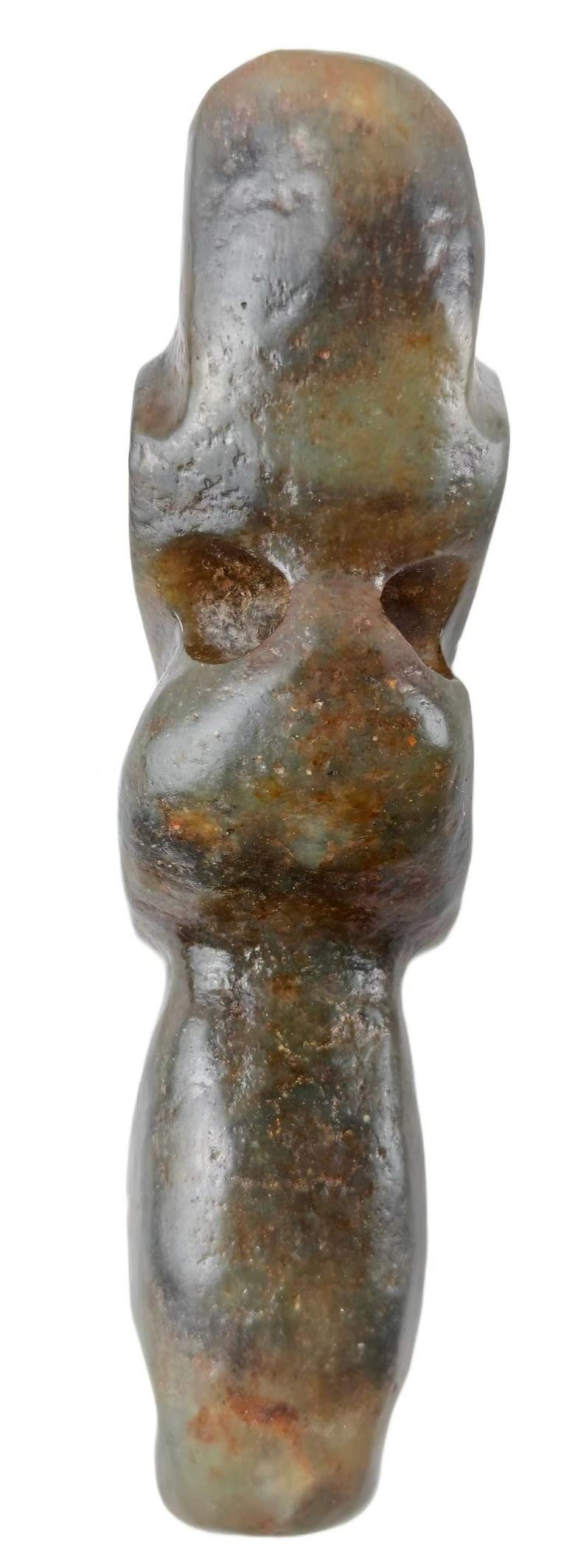
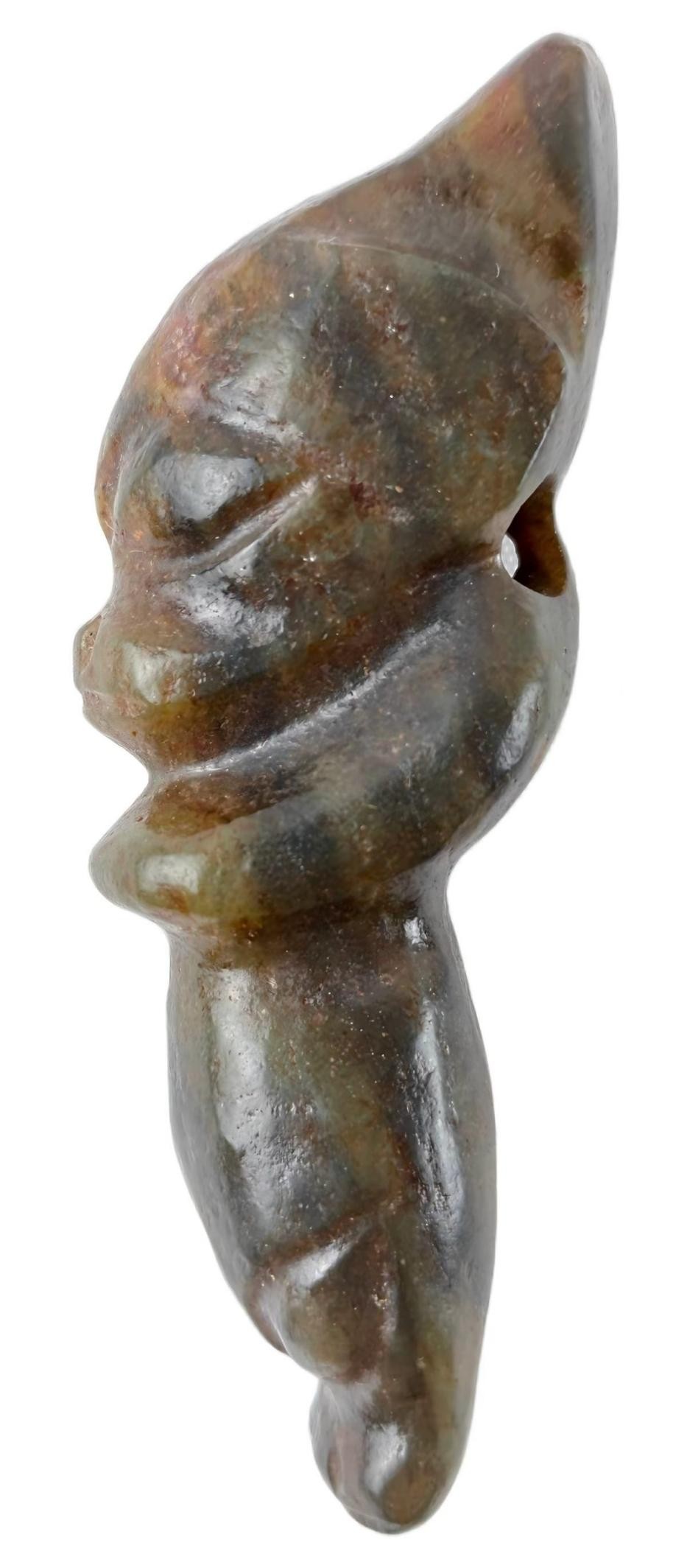
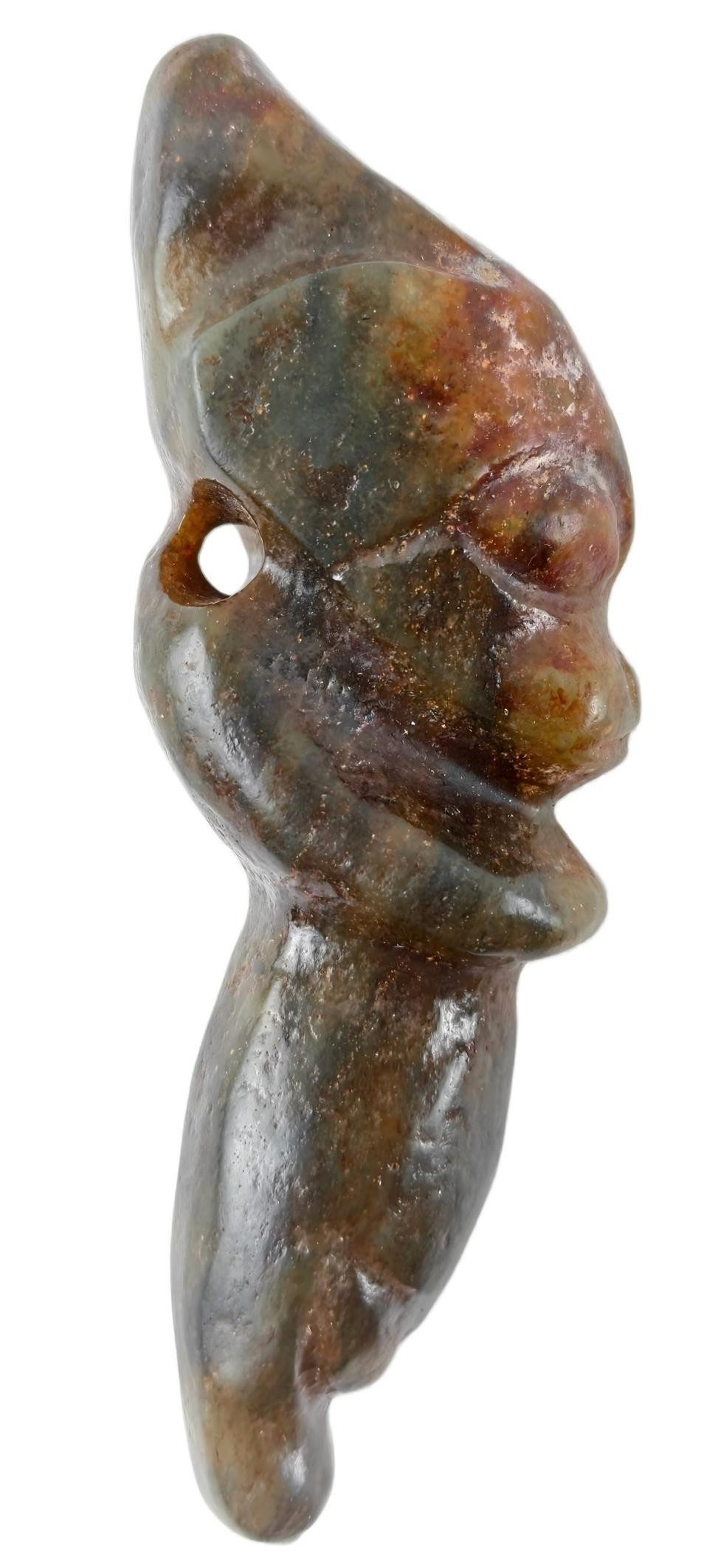
This jade figurine presents a stylized anthropomorphic image. The head rises upward in a pointed, crown‑like shape, symbolizing the radiance of the sun. The facial lines are concise and powerful, with protruding eyes, thick lips and distinct facial contour. The modelling does not pursue realistic portraiture. Instead, it adopts abstract, sacred stylization, separating the figure from ordinary mortal human beings, emphasizing its attribute of divinity rather than a mortal person.
On both sides of the head, penetrating perforations are skillfully carved. In Hongshan jade craft, perforations bear practical and ritual double meanings. Functionally, holes allowed the figurine to be strung and worn by wizards during sacrificial rituals. In religious symbolism, the holes are passages for the spirit to travel between heaven and earth. When the ancient wizard held or wore this jade sun‑god, he obtained the power to dialogue with solar divinity.
The torso is stout and compact, with thick neck and simplified limbs. The whole body proportion tends to be solid and powerful, not delicate or slender. The sculptor removed redundant decorative details, focusing on conveying solemn, mighty divine aura. This aesthetic is typical of Hongshan art: simple outer form, enormous inner spiritual tension.
Scholars have long debated the identity of Hongshan human‑form jades. Some researchers regard them as representations of sun‑god; some interpret them as tribal ancestor gods; others consider them the stone‑jade portrait of high‑rank wizards who were deified after death. In Hongshan primitive polytheism, boundaries between sun‑god, ancestor‑god and great wizard are blurred. The sun‑god figurine merges multiple layers of belief: it is the sun in sky, the ancestor protecting tribe, and the incarnation of wizardly sacred power.
When sacrificial rituals were held five thousand years ago, this jade might be placed on stone altar, hung on wizard’s body, or buried together with high‑status nobles, accompanying them to another world. Every handling, every sacrifice, every burial action was part of sacred religious practice. This small jade carrier bore the whole tribe’s hope for survival and prosperity.
Chapter Ⅲ Material, Craft, Weathering and Patina of the Present Figurine
This Sun‑God figurine is carved from high‑quality local nephrite originating from Hongshan cultural distribution zone. The jade material shows mixed tones of dark green, celadon, interspersed with reddish‑brown, ochre‑yellow rust patina formed by burial environment. The jade texture is dense and fine‑grained. After thousands of years of underground burial, the surface forms thick, moist ancient gloss, different from modern polished bright luster. It is the subdued, deep glow generated by long‑term jade ageing.
Observing carving traces, we can recognize classic Hongshan jade‑working techniques. In pre‑metal‑tool age, ancient craftsmen used stone tools, sand abrasives, rope‑string cutting and drilling to shape hard jade material. The surface retains the traces of grinding and chiselling from primitive craft. Lines are round and smooth yet retain hand‑made slight irregularities, never showing the mechanical uniform traces of modern machine carving.
The perforations are typical Hongshan double‑sided drilling technology. Holes are drilled from two opposite sides, forming the characteristic inner‑wall taper and overlapping drilling traces. This is an important craft feature of Hongshan jade artifacts.
The surface patina is multi‑layered. Reddish‑brown mineral rust permeates jade grain instead of merely sticking on surface. The transition between original jade color and burial‑induced patina is natural and gradual. The jade skin has weathered pits and tiny erosion marks produced by long‑term soil chemical corrosion. These are objective results of thousands‑year underground environment, cannot be artificially replicated in full.
We should understand: ancient jade patina is not merely “color on jade”. It is the mark left by time upon the artifact. Every patch of rust, every erosion pit records the environmental changes the jade experienced after being buried. For high‑ancient jade collectors, natural and authentic ancient weathering is equally important as modelling and historical connotation.
The overall preservation condition of this figurine is outstanding. Main body is complete, no destructive cracks or man‑made breakage. All original modelling features are fully retained. Among surviving Hongshan human‑form jade pieces, such integrity is quite rare.
Chapter Ⅳ The Status of Hongshan Sun‑God in Global High‑Ancient Jade Collection
In the international collecting circle, Chinese high‑ancient jade has long been highly valued by top collectors, museums and auction institutions. Hongshan jade represents the peak of Chinese pre‑historic jade art. Pig‑dragon, jade dragon and human‑form divine statues are always core sought‑after categories.
Compared with relatively more‑seen pig‑dragon and jade bird relics, human‑form divine statues including Sun‑God have far lower surviving quantity. Official archaeological excavations have yielded only a tiny number of human‑shaped Hongshan jade artifacts. Most specimens circulating in private collection world are limited in quantity. Fine‑condition complete Sun‑God figurines belong to top‑tier collectibles of Hongshan jade.
Overseas major museums such as the Metropolitan Museum of Art in New York, British Museum, and many important Asian art museums have collected Hongshan jade artifacts as key exhibits. High‑ancient Chinese jade has become an indispensable component of world pre‑historic art research. Western art historians gradually realize that East Asia already possessed highly advanced jade art system as early as 5000 years ago, parallel to ancient Egypt, Mesopotamia and other ancient civilizations.
For private collectors, collecting Hongshan Sun‑God is not merely investing in an antique artwork. It is obtaining a physical relic of the origin of Eastern spiritual civilization. Its value includes multiple dimensions: archaeological research value, cultural‑historical value, artistic aesthetic value, and scarce collection asset value.
High‑ancient jade collection differs from ordinary artwork collecting. It requires understanding of pre‑historic society, ancient jade craft, burial weathering, and cultural symbolic meaning. Excellent Hongshan human‑form jade is scarce resource. Fine intact specimens rarely appear in public auction market. Once presented, they draw wide attention from global collectors.
Many top‑tier private Asian art collections take high‑quality Hongshan jade as important cornerstone of their collection system. The Sun‑God figurine can serve as the highlight piece of any high‑ancient jade collection. It can balance your collection framework together with Liangzhu jade, Shang‑Zhou ritual jades and later imperial jades.
Chapter Ⅴ Artistic Aesthetics: Primitive Power and Abstract Sacredness
Modern viewers may feel that Hongshan Sun‑God’s modelling is not realistic by modern sculptural standards. But its artistic power lies exactly in its non‑realistic abstract expression. The Hongshan craftsman did not aim to carve a real human portrait. He wanted to shape divinity. He discarded trivial facial and body details, seized the core aura of power and sacredness, and condensed divinity into jade volume.
Thick, rounded body lines give the figurine solid sense of weight. Every curved surface flows naturally, showing superb grasp of jade material performance. The creator knew well the hardness and texture of nephrite, adjusted moulding according to jade characteristics, avoiding sharp fragile protruding parts. This reflects mature aesthetic and craft wisdom of Hongshan jade artisans.
There exists a special aesthetic charm shared by pre‑historic art across the world: rough yet grand, simple yet full of spiritual impact. Similar artistic temper can be seen in ancient Egyptian small divine statues, European pre‑historic stone idols, and Meso‑American jade god figures. Yet Hongshan Sun‑God carries unique Chinese cultural gene. Its worship system, jade‑using ritual, and spiritual connotation belong to the independent origin of East Asian civilization.
When you observe this figurine in hand, you can feel dual artistic appeal: on one hand, the primitive roughness from pre‑historic age; on the other hand, solemn divinity coming from religious ritual. It is small in physical size, yet generates huge spiritual visual shock. This is the highest realm of ancient sculptural art: conveying boundless spiritual power through limited physical object.
In contemporary art perspective, the abstract styling of Hongshan jade is surprisingly consistent with modern sculpture aesthetics. Many modern sculptors draw inspiration from pre‑historic oriental jade art. Five‑thousand‑year‑old jade statue can still resonate with modern aesthetic perception across time barrier. This is the eternal charm of great ancient artworks.
Chapter Ⅵ Religious and Cultural Significance: Sun Worship and Origin of Chinese Ancestor Faith
Sun worship is a global cultural phenomenon, but Hongshan sun belief has its own local Chinese characteristics. It is not isolated solar adoration. It is closely combined with ancestor worship. In Hongshan’s ideological world, outstanding ancestors after death could be fused with celestial divinities, gaining power over sun, moon, wind and rain. The Sun‑God figurine is the product of this integration of ancestor‑god and solar divinity.
This religious thought had profound long‑range influence on later Chinese culture. The concept that “ancestors can communicate with heaven” ran through Shang‑Zhou dynasty sacrificial system. Royal ancestors were considered able to plead to supreme celestial deity for the kingdom. We can trace the remote origin of this thought back to Hongshan Culture represented by this sun‑god jade.
Jade was the sacred medium for communication between human and god. Hongshan people believed jade possesses special spiritual quality. Jade can carry human prayer to heaven, and also convey divine blessing down to human world. This “jade as spirit‑medium” idea became the core of Chinese jade culture for thousands of years. From Hongshan, to Liangzhu, to Shang, Zhou, Han dynasties, jade ritual system continuously inherited and evolved.
Studying such human‑form jade relics helps us understand how Chinese early religion formed. Chinese civilization features continuity from pre‑history to historical era. Many core cultural concepts germinated in Neolithic age. The Sun‑God figurine is one of the key physical evidences for this continuity of civilization.
It is worth noting that Hongshan Culture proves that Northeast China is one of the important birthplaces of Chinese civilization. Previously, some old academic views overly focused on Yellow River basin as sole origin of Chinese civilization. Archaeological achievements of Hongshan together with many other regional Neolithic sites support the multi‑origin‑integration theory of Chinese civilization. This jade sun‑god is precious physical proof for this major academic proposition.
Chapter Ⅶ Collection Value Analysis: Scarcity, Heritage and Asset Attribute
When evaluating the collection value of Hongshan Sun‑God figurine, we need to examine multiple dimensions: historical information completeness, preservation status, modelling rarity, patina authenticity, cultural connotation, and market recognition.
First, scarcity. Human‑form divine statues are the rarest category among Hongshan jade artifacts. Complete pieces with clear sun‑god stylistic features are extremely limited. Most known specimens are museum‑held, unavailable for private transaction. Fine private‑collected examples seldom circulate in market. The law of supply and demand determines its solid collection foundation.
Second, preservation condition. This figurine keeps complete main body, no devastating damage. All original modelling and drilling features are fully preserved. Natural multi‑layer burial patina covers the surface. Good preservation largely retains all historical information carried by the artifact. Damaged or heavily repaired specimens will suffer great value discount. Integrity is critical for high‑ancient jade.
Third, cultural weight. As representative work of Hongshan top‑tier ritual jade, it bears pre‑historic cosmology, sun‑ancestor worship, and Neolithic jade‑craft technology. It is not an ordinary decorative pendant. It is a tribal sacred object. Artifacts with heavy cultural theme always enjoy higher long‑term attention in collecting circle.
Fourth, market trend. In recent decades, global market recognition for Chinese Neolithic high‑ancient jade keeps rising. Top‑quality Hongshan jade pieces have repeatedly achieved remarkable performance in international auction houses. More institutional collectors and private connoisseurs begin to attach importance to pre‑historic jade relics, not only focusing on late imperial jade. The market value of rare Hongshan ritual jade has steady upward potential.
Meanwhile, we should objectively recognize: high‑ancient jade collection has professional threshold. It requires accumulative knowledge of jade material, ancient craft, burial weathering and stylistic evolution. Serious collectors value authentic ancient traces more than superficial appearance. This figurine possesses complete set of ancient characteristics, which constitutes its core collection foundation.
As a tangible cultural heritage, this Sun‑God figurine carries historical responsibility. For its owner, it is not only a collectible asset, but also a guardian of 5000‑year‑old pre‑historic cultural memory. Good collection includes proper preservation, research, display and inheritance, letting later generations also appreciate the glory of Hongshan civilization.
Chapter Ⅷ Appreciation Guide: How to Observe This Sun‑God Figurine
For connoisseurs and researchers, we can appreciate this artifact from multiple angles.
Observe modelling: appreciate overall silhouette from front, side, back perspectives. Notice the upward‑tilted sun‑crown‑shaped head, stylized facial features, stout torso, simplified limb treatment. Feel the balance between abstract divinity and physical jade volume.
Observe craft details: examine double‑sided drilled perforations, observe inner‑wall trace of drilling. Examine surface grinding traces left by primitive abrasive tools. Notice slight natural unevenness of hand‑carved lines, different from uniform machine‑made lines.
Observe jade material and patina: distinguish original jade matrix and burial‑induced rust color. Observe permeation status of patina inside jade texture. Observe surface weathering erosion pits formed by long‑term soil corrosion. Appreciate the moist, subdued ancient gloss formed by thousands‑year jade ageing.
When held in hand, feel the weight of nephrite. Experience the tactile difference between ancient weathered jade surface and modern polished jade. Every detail accumulates the mark of five thousand years of time.
High‑ancient jade appreciation cannot rely on single feature. We need comprehensive judgment combining styling, craft, jade material, patina and weathering traces. Every single feature should be mutually corroborated. This figurine presents consistent and coordinated ancient characteristics across all dimensions.
Chapter Ⅸ The Contemporary Meaning of Collecting Hongshan Sun‑God
Today, we live in a highly modernized digital society. Why do we still need to pay attention to a five‑thousand‑year‑old pre‑historic jade figurine?
It lets us trace back to the origin of our cultural spirit. When modern people are trapped in fast‑paced material life, facing this relic from civilization dawn, we can think about how ancient ancestors understood heaven, earth, life and universe. Their awe toward nature, their pursuit of good fortune for tribe, still can bring spiritual inspiration for modern people.
For art lovers, pre‑historic jade breaks the stereotype that “ancient Chinese art only mature in historical dynasties”. Hongshan jade proves that brilliant art creation already bloomed on this land in Neolithic times. Its abstract expressive language can inspire modern creation.
For collectors, this Sun‑God figurine is a rare chance to obtain top‑tier pre‑historic cultural relic. It can become the centrepiece of private collection, suitable for academic research, private exhibition, inheritance for descendants. It crosses commercial value, and bears cultural heritage mission.
In international cultural exchange, high‑quality Hongshan jade is powerful cultural business card. It can help overseas audiences understand the long‑standing and splendid pre‑historic civilization of East Asia, showing the long origin of Chinese jade art.
This jade figurine was made by anonymous craftsman five thousand years ago. No name was left. But his work survives through millenniums. The divinity imagined by Hongshan ancestors is solidified in nephrite. When we gaze at it today, we build spiritual connection with remote pre‑historic times.
Conclusion
This Hongshan‑culture Sun‑God figurine is a surviving precious legacy from the twilight of Chinese civilization. Condensed with Neolithic sun‑ancestor worship wisdom, forged by primitive jade‑working craft, tempered by thousands‑year underground burial, it carries abundant information of archaeology, religion, art and collection.
It is the sacred totem of Hongshan tribe, the masterpiece of pre‑historic oriental sculptural art, and a highly scarce high‑ancient jade collectible worthy of serious collection. Every curve, every rust patch, every drilling trace records the distant age long before written history.
From the banks of ancient Liao River five thousand years ago, to modern collector’s hands across time, this jade sun‑god still radiates solemn primitive charm. To own it is to hold a fragment of the dawn of Eastern civilization.